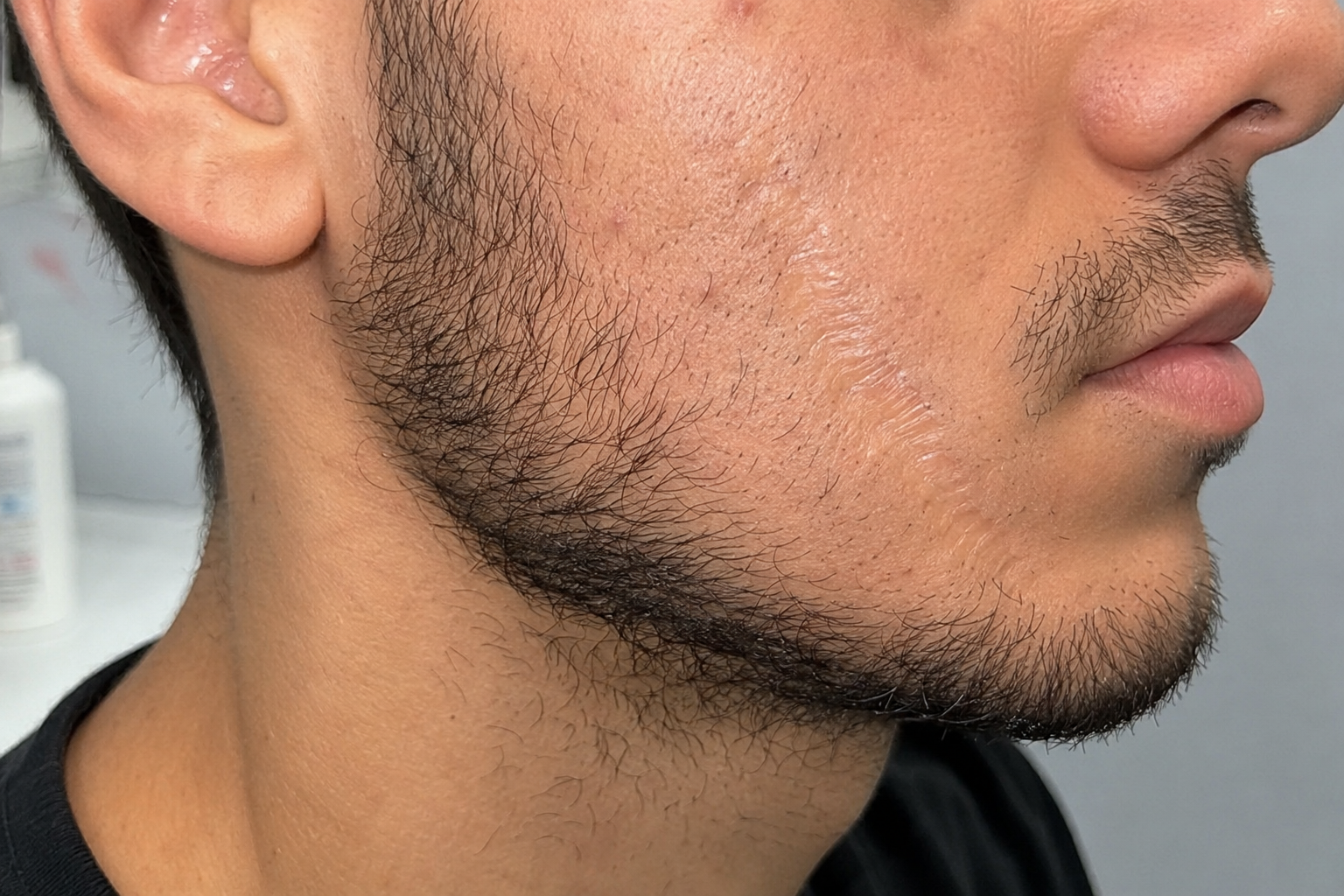

A scar on the face can become a real source of discomfort, especially when it is located in an area where the beard would normally grow. After a burn, a deep cut, surgery, an accident, or even severe acne, hair may no longer grow properly on the affected area. This lack of facial hair creates an empty patch that can be very visible and may contrast strongly with the rest of the beard. For many men, this irregularity gives the impression of an incomplete, poorly shaped, or asymmetrical beard. Today, thanks to modern beard transplant techniques, it is possible to camouflage a scar, reduce the appearance of an old mark, and restore a more even beard with a natural and long-lasting result.
Why Can a Scar Prevent Beard Growth?
A scar forms when the skin has suffered a deep injury that changes its structure. In the case of a facial burn, a serious wound, or a surgical procedure, the skin repairs itself, but it does not always return to its original condition. Scar tissue may become thinner, thicker, tighter, or less vascularized. Most importantly, the hair follicles responsible for beard growth may be permanently destroyed.
When a hair follicle is destroyed, the beard can no longer grow naturally in that area. This is why some scars remain visible for years, even when the skin appears fully healed. For men who wear a beard, this lack of hair can make the mark stand out even more, because the difference between the bearded area and the hairless zone becomes more obvious. A beard transplant on a scar can reimplant new follicles to recreate hair growth in the affected area.
Can a Beard Transplant Really Camouflage a Scar?
Yes, in many cases, a beard transplant on a scar can effectively camouflage a mark, burn, or old injury. The principle is to extract hair follicles from a donor area, usually at the back of the scalp, and implant them directly into or around the scar. Once implanted, these follicles can produce new hairs that gradually grow and blend with the existing beard.
The goal is not always to make the scar disappear completely, but to make it much less visible. Thanks to the density created by the new hairs, the mark blends more naturally into the beard. In some cases, it can become almost unnoticeable to the naked eye. However, the result depends on several factors: skin quality, scar age, depth, flexibility, blood supply, and the experience of the practitioner.
How Does a Beard Transplant on a Scar Work?
The most commonly used technique for this type of procedure is FUE, also known as Follicular Unit Extraction. This method involves extracting follicles one by one, without leaving a large linear scar in the donor area. The grafts are then sorted, prepared, and implanted precisely into the area to be corrected.
For a beard transplant on a burn or scar, the work requires special attention. Scar tissue does not always have the same elasticity as normal skin. It may be more fragile, less flexible, or less well supplied with blood. The specialist must therefore adapt the implantation depth, hair angle, and graft density to achieve good regrowth and a natural aesthetic result.
The success of the procedure also depends on respecting the natural direction of beard growth. Hairs do not grow in the same direction on the cheeks, chin, mustache, or jawline. A well-performed implantation must follow these natural directions to avoid an artificial look.
Is a Beard Transplant Possible After a Burn?
A beard transplant after a burn is possible in many cases, provided the skin is stable and sufficiently healed. A burn can destroy hair follicles and leave an area completely without beard growth. When the scar is old, flat, and well vascularized, the chances of good regrowth are generally better.
However, not all burns can be treated in the same way. A deep burn may make the skin tighter or less receptive to grafts. In this case, the doctor may recommend a gradual approach, with moderate density during a first session and a second procedure if necessary. This strategy helps respect the quality of the skin and optimize the final result.
What Types of Scars Can Be Corrected?
Every scar must be evaluated individually. Some are easier to treat, while others require more caution. The best indications are generally old, stable, flat, and flexible scars. Thicker, red, painful, or evolving scars should be examined carefully before considering implantation.
| Type of Scar | Effect on the Beard | Possibility of Transplant | Expected Result |
|---|---|---|---|
| Old flat scar | Well-defined hairless area | Very favorable | Natural camouflage |
| Surgical scar | Visible line in the beard | Favorable | Significant reduction in visibility |
| Deep acne scar | Irregular or patchy beard | Possible depending on the skin | Improved density |
| Old burn | Destroyed follicles, weakened skin | Possible after diagnosis | Gradual result |
| Keloid scar | Thick, raised skin | Special case | Medical assessment required |
This table shows that a beard transplant for scars can address several situations, but a personalized diagnosis remains essential. A recent scar should generally not be treated too early. It is often recommended to wait several months, sometimes up to a year, so that the skin is fully stabilized.
Why Choose Turkey for a Beard Transplant on a Scar?
Turkey has become one of the most popular destinations for beard transplant and hair transplant procedures. Istanbul welcomes many international patients every year who want to correct a patchy beard, increase mustache density, or camouflage a scar. This reputation is due to the experience of medical teams, the high number of procedures performed, and the use of modern techniques such as FUE and Sapphire FUE.
A beard transplant in Turkey is also attractive because of its value for money. Specialized clinics often offer complete packages including consultation, the procedure, post-operative care, hotel accommodation, transfers, and follow-up. For patients coming from France, Belgium, Switzerland, or other European countries, this organization makes the medical trip easier and provides structured care.
For a beard transplant on a scar, it is essential to choose an experienced clinic, because implantation on scar tissue requires more precision than a standard transplant. The practitioner must know how to adapt density, select the right grafts, and respect the particular nature of the injured area.
| Comparison Criteria | Turkey | France / Western Europe |
|---|---|---|
| Beard transplant price | Generally more affordable | Often higher |
| Medical packages | Often all-inclusive | Rarely included |
| Experience in FUE transplant | Very high international demand | Varies depending on the center |
| Organized medical stay | Hotel, transfers, and follow-up possible | Often organized separately |
| Complex beard cases | Common in specialized clinics | Depends on practitioner experience |
Turkey is not chosen only for its price. It also attracts patients looking for specific expertise in beard implantation, especially for delicate areas such as scars, burns, or completely hairless zones.
How Does a Beard Transplant on a Scar Take Place?
The process begins with a consultation or medical evaluation. The specialist analyzes the scar, observes the existing beard, and determines the number of grafts needed. This step also checks whether the skin is healthy enough to receive implants. In some cases, photos are requested before travel to provide an initial estimate.
On the day of the procedure, the donor area is prepared. Follicles are carefully extracted, usually from the back of the head. The doctor then draws the area to be corrected on the face. This step is important because the transplant must respect the natural beard line, facial balance, and the patient’s expectations.
The grafts are then implanted one by one into the scar. The practitioner must respect the exit angle of the hairs so that the future beard looks natural. On a scar, implantation can be more delicate because the skin may be less flexible. This is why technique, patience, and experience play an essential role in the final result.
How Many Grafts Are Needed to Camouflage a Scar?
The number of grafts depends on the size of the scar, the desired density, and the existing beard around the area. A small scar on the cheek may require only a few hundred grafts. A larger burn or a significant hairless area may require a higher number.
| Area to Treat | Average Number of Grafts | Aesthetic Goal |
|---|---|---|
| Small localized scar | 100 to 300 grafts | Reduce visibility of the mark |
| Medium cheek scar | 300 to 700 grafts | Harmonize beard density |
| Scar in the mustache area | 200 to 500 grafts | Redefine the mustache line |
| Extensive burn | 700 to 1500 grafts or more | Gradually rebuild hair coverage |
| Patchy beard with scar | Variable | Increase density and even out the beard |
The goal is not always to achieve maximum density. In some cases, moderate density is enough to make the scar much less visible. The purpose is to create a natural effect that matches the rest of the beard.
Does a Beard Transplant on a Scar Look Natural?
A natural result is possible when the procedure is performed with precision. The new hairs grow gradually and can be maintained like a normal beard. Once regrowth is complete, it is possible to shave, trim, or shape the beard according to personal preference.
Regrowth happens in stages. During the first few weeks, the implanted hairs may fall out. This is normal and does not mean the transplant has failed. The follicles remain under the skin, then produce new hairs over the following months. Early visible results often appear around the third or fourth month. The final result is generally seen between 10 and 12 months.
In the case of scar tissue, regrowth may sometimes be slower or less uniform. This is why post-operative follow-up is important. The doctor may recommend specific care to support healing and graft survival.
What Care Is Needed After a Beard Transplant?
After a FUE beard transplant, it is normal to see redness, small scabs, and mild sensitivity in the implanted area. These reactions are temporary and part of the healing process. The patient must avoid scratching, rubbing, or touching the grafts during the first few days.
It is also recommended to avoid sun exposure, excessive sweating, early shaving, and harsh products on the skin. The clinic’s instructions must be followed carefully. Good post-operative care improves the chances of regular regrowth.
The transplanted beard can then be maintained normally once healing is complete. The implanted hairs become permanent and continue growing like other beard hairs.
What Are the Benefits of a Beard Transplant to Camouflage a Scar?
A beard transplant for scars offers several advantages. First, it reduces the visual appearance of a mark that can be difficult to accept in daily life. Unlike corrective makeup or temporary solutions, a transplant offers a long-lasting result because the implanted follicles produce real hair.
This procedure also helps restore a more balanced beard. A scar that used to interrupt the beard or create a visible gap can be naturally integrated into the overall facial hair. The face appears more harmonious, and the mark draws much less attention.
For some patients, the aesthetic improvement also brings a real psychological benefit. After a burn, accident, or surgery, regaining an even beard can help turn the page and feel better about one’s appearance.
What Are the Risks or Limitations?
Although a beard transplant on a scar often gives good results, it must be approached with realistic expectations. The scar does not always disappear completely. It is camouflaged by the hairs, but skin quality remains an important factor. A very thick, hard, or poorly vascularized scar may limit graft survival.
The risks are generally low when the procedure is performed under proper conditions, but they still exist. Possible issues include partial regrowth, insufficient density, irritation, infection, or incorrect hair direction if the technique is not well controlled. This is why the choice of practitioner and clinic is crucial, especially for implantation on scar tissue.
Beard Transplant in Turkey: A Solution for Facial Scars
For men who want to camouflage a burn, mark, or old injury, a beard transplant in Turkey can be an interesting option. Specialized clinics in Istanbul are used to treating different patient profiles, including beard densification, partial reconstruction, and correction of hairless areas.
A good clinic will always take the time to assess the scar before suggesting a procedure. It will explain the possibilities, limitations, estimated number of grafts, and regrowth timeline. This transparency is essential to achieve a natural result and avoid unrealistic promises.
A transplant can transform the appearance of a scar, but it remains a serious medical procedure. The result depends on technique, practitioner expertise, skin quality, and proper healing after the intervention.
Complete FAQ About Beard Transplant and Scars
Can a beard transplant completely camouflage a scar?
A beard transplant can make a scar much less visible, sometimes almost unnoticeable, but the result depends on the skin, the size of the mark, and the quality of regrowth. The goal is to blend the scar into the existing beard by implanting new hairs.
Can a beard transplant be performed on an old burn?
Yes, a beard transplant on an old burn is possible if the skin is stable, fully healed, and sufficiently vascularized. A medical evaluation is essential to check whether the area can receive grafts.
How long should you wait after an injury or burn?
It is generally better to wait several months before considering a transplant. In many cases, the scar should be allowed to evolve for 6 to 12 months so the skin becomes stable and the doctor can better assess the feasibility of the procedure.
Is a beard transplant on a scar painful?
The procedure is performed under local anesthesia, sometimes with sedation depending on the clinic. Pain during the operation is usually very limited. After the procedure, mild sensitivity may appear for a few days.
Do hairs transplanted onto a scar grow permanently?
Yes, when the grafts take properly, the implanted hairs grow permanently. They can then be shaved, trimmed, and maintained like a natural beard.
Is regrowth as good on a scar as on normal skin?
Regrowth can be very good, but it depends on the quality of the scar. Soft, well-vascularized skin promotes better graft survival. Hard, thick, or weakened skin may sometimes lead to more uneven regrowth.
How many grafts are needed for a scar on the cheek?
A small scar on the cheek may require around 100 to 300 grafts. A larger scar may require 300 to 700 grafts, or more depending on the area to cover and the desired density.
Can a scar in the mustache area be corrected?
Yes, a mustache transplant can help camouflage a scar above the upper lip. Implantation must be very precise because mustache hairs have a specific direction and play an important role in facial expression.
Can you shave a transplanted beard on a scar?
Yes, once healing is complete and regrowth is established, the transplanted beard can be shaved or trimmed normally. The implanted hairs behave like natural hairs.
When can you see the final result?
Early results usually appear after 3 to 4 months. Density then continues to improve gradually. The final result of a beard transplant on a scar is often visible between 10 and 12 months.
Why choose Turkey for a beard transplant?
Turkey is recognized for its expertise in beard transplant, modern techniques such as FUE, and organized medical packages. Many patients choose Istanbul to benefit from specialized procedures at prices often more accessible than in Western Europe.
What is the price of a beard transplant on a scar in Turkey?
The price depends on the number of grafts, the complexity of the scar, and the clinic chosen. In general, prices in Turkey are more competitive than in many European countries, with packages that may include hotel accommodation, transfers, and follow-up care.
Is one session enough to camouflage a scar?
In many cases, one session is enough. However, for an extensive burn, a very large scar, or difficult scar tissue, a second session may be considered to improve density.
Does a beard transplant leave new scars?
With the FUE method, follicles are extracted one by one, which limits visible marks. The tiny extraction points usually heal very well and become almost invisible.
Who can benefit from a beard transplant on a scar?
This procedure may be suitable for men with a hairless area caused by a scar, burn, surgery, injury, or accident. Feasibility must always be confirmed by a personalized medical diagnosis.
