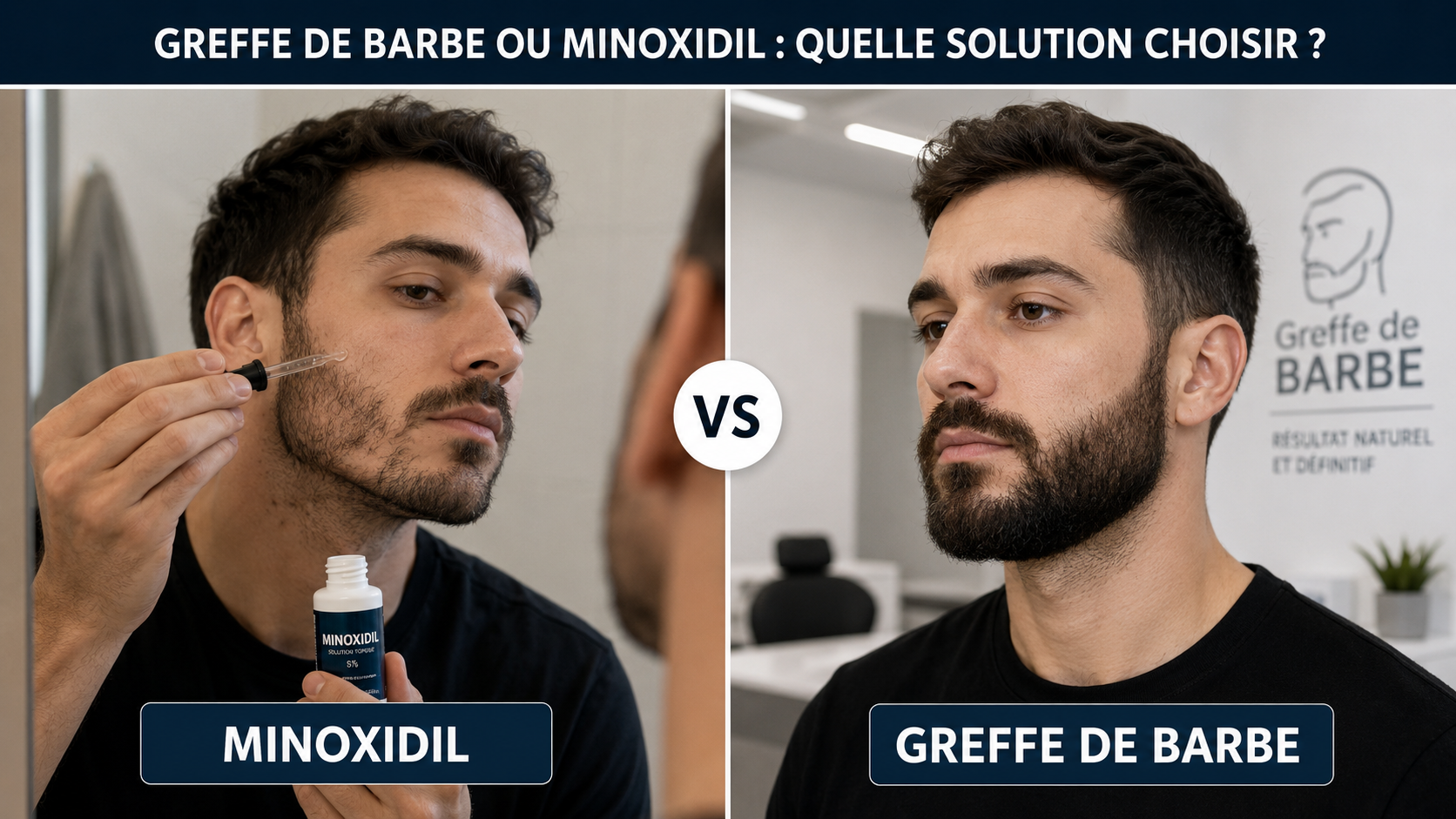

Having a dense, well-defined, and even beard has become an important aesthetic goal for many men. However, not everyone naturally has a full beard. Some men have a patchy beard, gaps in the beard, a thin mustache, or little to no hair growth on the cheeks. When faced with this issue, two solutions often come up: beard transplant and minoxidil for beard growth. However, these two options do not work in the same way, do not offer the same results, and do not have the same limitations. Minoxidil can help stimulate growth in some cases, while a beard transplant allows new hair follicles to be implanted directly into sparse or hairless areas. The right choice therefore depends on your situation, your age, your natural facial hair, your expectations, and the result you want to achieve.
Understanding the Difference Between Beard Transplant and Minoxidil
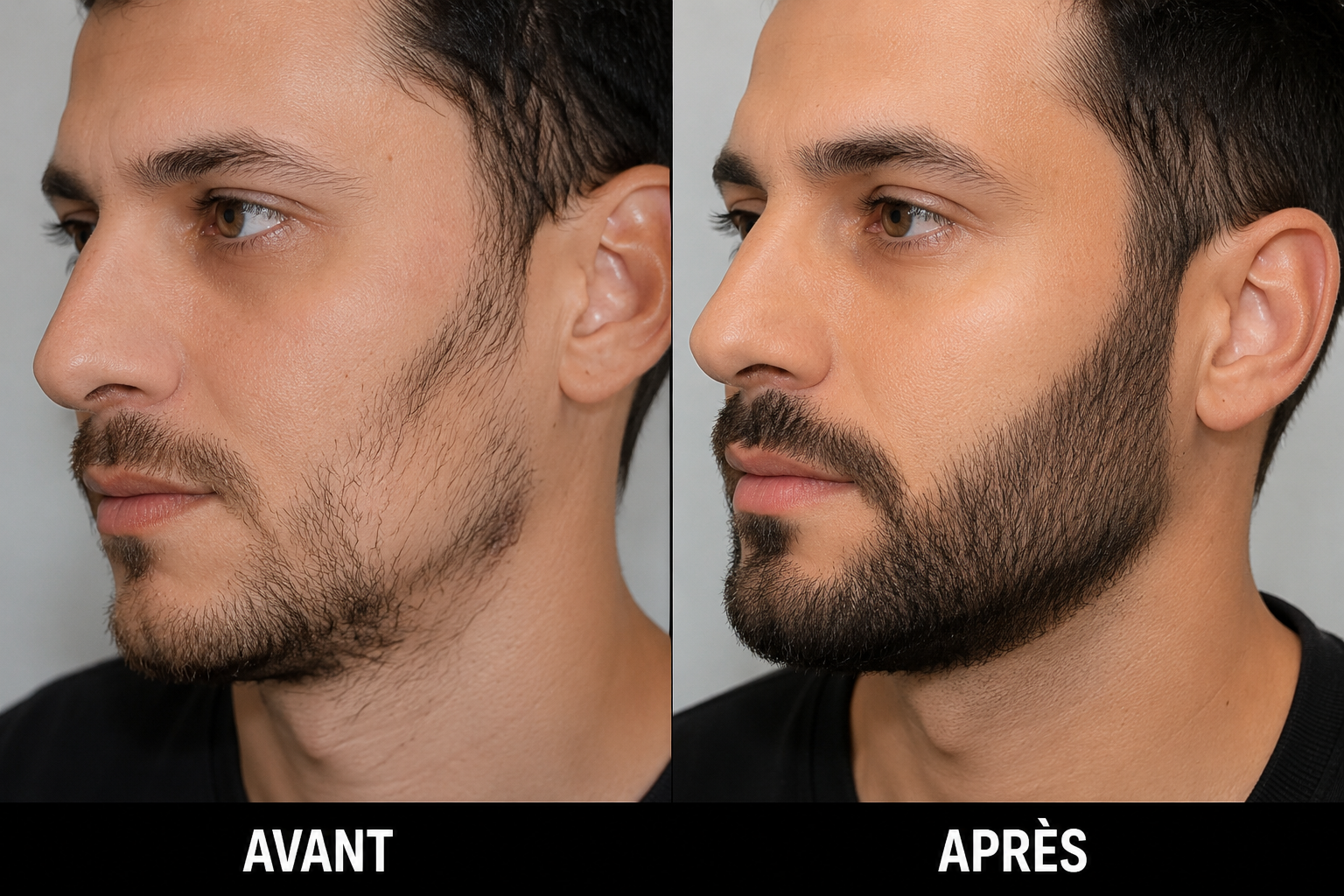
A beard transplant is a medical procedure that involves extracting hair follicles from a donor area, usually at the back of the scalp, and implanting them into areas of the face where the beard is missing or too thin. The implanted follicles then produce new hair permanently. This solution is especially suitable for men who want to fill in gaps, redefine their beard line, increase cheek density, strengthen the mustache, or correct areas with no facial hair.
Minoxidil, on the other hand, is a topical solution applied directly to the skin. It is mainly known for treating hair loss, but some men also use it to stimulate beard growth. Its goal is to activate existing follicles under the skin. Minoxidil does not create new follicles. It may help fine hairs become more visible, but it cannot grow a dense beard in an area where there are no active follicles.
How Does Minoxidil Work for Beard Growth?
Minoxidil for beard growth works by stimulating local blood circulation and extending the hair growth phase. In some areas of the face, it may help thicken very fine hairs, often called peach fuzz, and gradually make them darker and more visible. This is why some men notice improvement after several months of regular use.
However, results vary greatly from one person to another. A man who already has a significant amount of fine facial hair on the cheeks may see visible improvement. On the other hand, if an area is completely lacking active hair follicles, minoxidil is unlikely to produce a satisfying result. It is also important to understand that a minoxidil beard treatment requires patience and consistency. First changes may appear after several months, and stopping the product can lead to the loss of part of the results, especially if the stimulated hairs have not fully matured.
How Does a Beard Transplant Work?
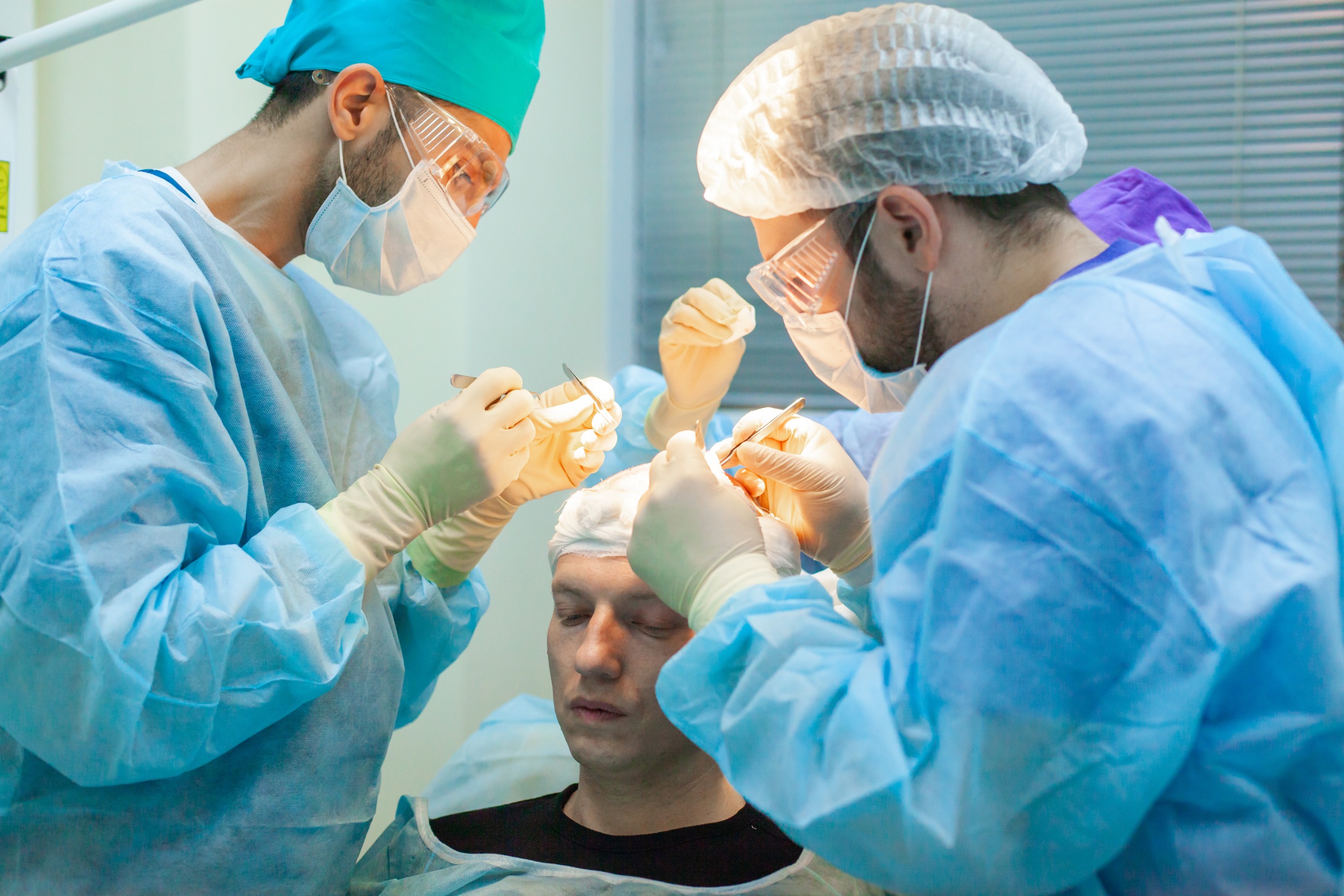
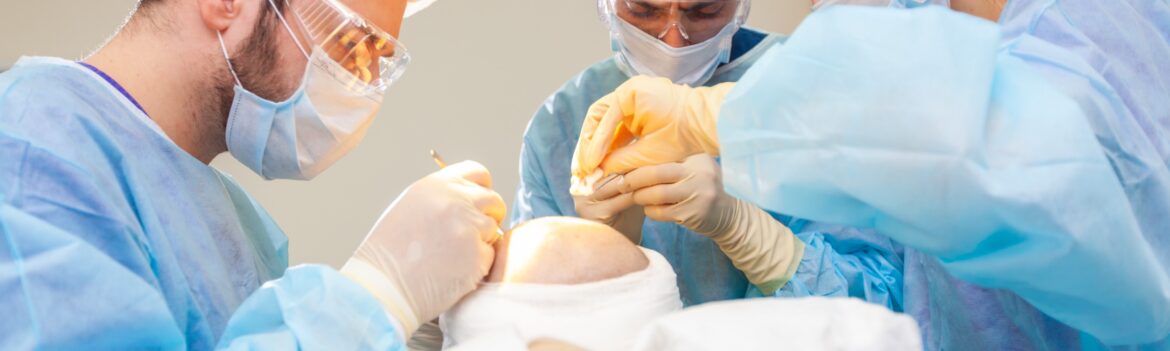
A FUE beard transplant is a more direct method. The practitioner extracts follicular units one by one from the donor area, then implants them into the areas of the face that need more density. This technique allows precise work on the cheeks, chin, mustache, sideburns, or jawline. The goal is to create a natural beard that suits the patient’s facial structure and desired style.
Unlike minoxidil, a transplant does not depend only on the presence of existing follicles on the face. It adds new follicles to sparse areas. This is why it is often recommended when the beard is very uneven, when there are completely empty areas, or when a patient wants a more predictable and long-lasting result.
Beard Transplant or Minoxidil: Quick Comparison
| Criterion | Minoxidil for Beard | Beard Transplant |
|---|---|---|
| Principle | Stimulates existing follicles | Implants new follicles |
| Result | Variable depending on the person | More predictable |
| Treatment duration | Several months, regular use | Usually performed in one day |
| Long-lasting result | Not always, especially after stopping | Yes, if the grafts take well |
| Completely hairless areas | Limited effectiveness | Very suitable |
| Mild patchy beard | May be useful | Possible if more density is needed |
| Very uneven beard | Limited result | More complete solution |
| Initial cost | Lower at first | Higher at first |
| Maintenance | Regular application | Normal beard maintenance after regrowth |
This table shows that minoxidil for beard growth can be an interesting option in some cases, but it does not address the same needs as a beard transplant. Minoxidil is a gradual solution that depends on how the skin and follicles respond, while a transplant is a more structured medical solution, especially when the goal is to clearly rebuild or densify the beard.
When Should You Choose Minoxidil for Beard Growth?
Minoxidil for beard growth may be considered when the beard is slightly patchy but fine hairs are already present. It may be useful for younger men whose facial hair is still developing, or for those who want to try a non-surgical solution before considering a procedure. It may also suit people who are not looking for a major transformation, but rather a gradual improvement in density.
However, its limitations must be understood. Minoxidil requires regular application, often once or twice daily depending on the product or medical recommendation. It can cause side effects such as irritation, dry skin, itching, or redness. Some people do not tolerate the product well, especially on the face, where the skin can be more sensitive than the scalp.
Minoxidil can therefore be a first step for men with a low-density beard, but it should not be seen as a miracle solution. Results are never guaranteed and depend heavily on genetics.
When Should You Choose a Beard Transplant?
A beard transplant is generally more suitable when gaps are significant, when the cheeks are almost hairless, when the mustache is absent, or when one area of the face does not produce hair. It can also be recommended to correct a scar in the beard, an old burn, or a visible asymmetry.
This solution is especially suitable for men who want a more durable and visible result. Once the follicles are implanted and regrowth is complete, the transplanted hairs can be shaved, trimmed, and maintained like a natural beard. The final result appears gradually, often between 10 and 12 months after the procedure.
A transplant is also interesting for men who have already tried minoxidil without achieving satisfying results. In that case, it provides a more concrete solution for areas that do not respond to stimulating treatments.
Can Minoxidil Replace a Beard Transplant?
Minoxidil can improve some cases of patchy beard growth, but it cannot replace a beard transplant when areas are completely bald. Its action depends on follicles that are already present. If there is no hair base, the product cannot create a full beard on its own.
It can therefore be useful for slightly increasing the density of an existing beard, but it will often be insufficient to rebuild a beard line, fill large gaps, or create a beard on hairless cheeks. For men looking for a clear transformation, a transplant generally remains the most effective solution.
Can You Use Minoxidil After a Beard Transplant?
In some cases, a doctor may recommend complementary products after a beard transplant, but this should always be done with professional guidance. After the procedure, the skin must heal properly. Irritating products should not be applied too soon to the implanted areas.
Minoxidil may sometimes be considered later to support density or stimulate existing hairs, but it should not be used without medical advice after a transplant. Post-operative care remains the priority to protect the grafts and encourage good regrowth.
Beard Transplant in Turkey: Why Is This Option So Popular?
A beard transplant in Turkey has become a highly sought-after option among international patients. Istanbul is now widely known for hair transplant, beard transplant, and mustache transplant procedures. Many Turkish clinics have strong experience with modern techniques such as FUE and Sapphire FUE, with teams used to treating different beard profiles.
Turkey is also attractive because of its value for money. Prices are often more accessible than in Western Europe, especially compared with France, Belgium, or Switzerland. Many clinics offer packages including the procedure, hotel, transfers, and post-operative follow-up. For patients hesitating between several solutions, Turkey can be an interesting alternative when they want a lasting result without years of treatment.
However, choosing the right clinic remains essential. The decision should not be based only on price. A natural beard transplant requires real aesthetic expertise, because facial hairs must be implanted with the right angle, the right density, and a beard line adapted to the patient’s facial structure.
Cost: Minoxidil or Beard Transplant, Which Is More Economical?
At first, minoxidil for beard growth seems much cheaper than a transplant. It is purchased as a product to be applied regularly, which represents a monthly cost. But over time, the budget can increase, especially if the treatment must be continued for many months or years to maintain results.
A beard transplant, on the other hand, represents a higher initial investment, but it aims for a long-lasting result. Once regrowth is achieved, there is no need to apply a daily product to maintain transplanted hairs. The most economical choice therefore depends on the real need. For a slight improvement, minoxidil may be enough. For a major transformation, a transplant may be more logical in the long term.
| Situation | Often the Most Suitable Solution | Why? |
|---|---|---|
| Peach fuzz present but low beard density | Minoxidil | May stimulate existing hairs |
| Visible gaps in the beard | Beard transplant | Allows new follicles to be implanted |
| Almost hairless cheeks | Beard transplant | Minoxidil may be limited |
| Young beard still developing | Minoxidil or waiting | Facial hair may evolve naturally |
| Hairless scar | Beard transplant | Follicles have often been destroyed |
| Desire for a lasting result | Beard transplant | Grafts are permanent |
| Limited short-term budget | Minoxidil | Lower initial cost |
Natural Result: Which Solution Gives the Best Appearance?
A natural result depends on the quality of the existing beard, the desired density, and the technique used. With minoxidil, when the product works, the hairs that appear can look natural because they come from the face’s own follicles. However, the result often remains gradual and sometimes incomplete.
With a FUE beard transplant, the result can be very natural if the procedure is performed correctly. The practitioner must respect the direction of hair growth, avoid a line that is too straight, and adapt density to each area of the face. A beard that is too uniform or too sharply drawn can look artificial. This is why the specialist’s experience plays a key role.
What Are the Risks and Side Effects?
Minoxidil for beard growth may cause skin-related side effects, including redness, dryness, irritation, or itching. Some people may also experience increased skin sensitivity. If a significant reaction occurs, it is better to stop using the product and seek medical advice.
A beard transplant also involves normal after-effects such as redness, small scabs, mild swelling, or temporary sensitivity. These effects usually disappear over time. The main risks are related to poor implantation, uneven density, infection, or an unnatural result if the clinic lacks experience.
In both cases, it is best not to improvise. The face is a visible and sensitive area. Professional advice helps avoid mistakes and choose the most suitable solution.
Which Solution Should You Choose Based on Your Goal?
If your goal is to slightly stimulate a beard that is still developing, minoxidil for beard growth may be a first option to consider. It may be useful if you already have peach fuzz or some facial hair on the cheeks. However, if you want to fill significant gaps, redesign your beard, correct asymmetry, or achieve lasting density, a beard transplant will often be more suitable.
The choice also depends on your patience. Minoxidil requires a regular routine and uncertain results. A transplant requires a larger initial investment, but it offers a more definitive solution when the grafts take properly.
Beard Transplant or Minoxidil: The Right Choice Depends on Your Profile
There is no single answer that applies to everyone. A 22-year-old man with a beard that is still developing will not have the same needs as a 35-year-old man with almost hairless cheeks. Likewise, a small patchy area does not necessarily require the same approach as a scar or a complete absence of beard growth.
The most important thing is to analyze your real situation. Do you already have fine hairs in the areas concerned? Is your beard still developing? Do you want a slight improvement or a visible transformation? Are you ready to apply a treatment for several months? Are you looking for a lasting solution? These questions help guide the choice between minoxidil and beard transplant.
FAQ – Beard Transplant or Minoxidil
Does minoxidil really make the beard grow?
Minoxidil can stimulate beard growth in some men, especially when active follicles or peach fuzz are already present. However, it does not create new follicles and does not work for everyone.
Does a beard transplant give a permanent result?
Yes, the hairs implanted during a beard transplant are generally permanent when the grafts take properly. They can then be shaved, trimmed, and maintained like natural hairs.
Which solution is faster?
Neither solution gives an immediate final result. Minoxidil requires several months of regular use. A beard transplant also requires gradual regrowth, with the final result often visible between 10 and 12 months.
Can minoxidil fill large gaps in the beard?
Minoxidil for beard growth can improve some sparse areas, but it is often limited when it comes to large gaps or completely hairless zones. In that case, a beard transplant is generally more suitable.
Can you have a beard transplant after trying minoxidil?
Yes, it is possible to consider a beard transplant after trying minoxidil, especially if the results are insufficient. A consultation will determine the number of grafts needed.
Is minoxidil dangerous for the face?
Minoxidil can cause irritation, dryness, or redness. It should be used carefully, ideally after medical advice, especially on sensitive skin.
Is a beard transplant painful?
A FUE beard transplant is performed under local anesthesia. Pain during the procedure is usually minimal. After the operation, mild sensitivity may appear for a few days.
Why choose Turkey for a beard transplant?
Turkey is known for its expertise in beard transplant, modern techniques, and medical packages that are often more affordable than in Western Europe. Istanbul is especially well known for this type of procedure.
What is the best choice for a patchy beard?
For a slightly patchy beard with existing peach fuzz, minoxidil may be tried. For a very uneven beard with large gaps or hairless areas, a beard transplant is often more effective.
Can minoxidil and beard transplant be combined?
In some cases, both can be combined, but only with professional advice. After a transplant, the skin must heal before applying any stimulating product.